
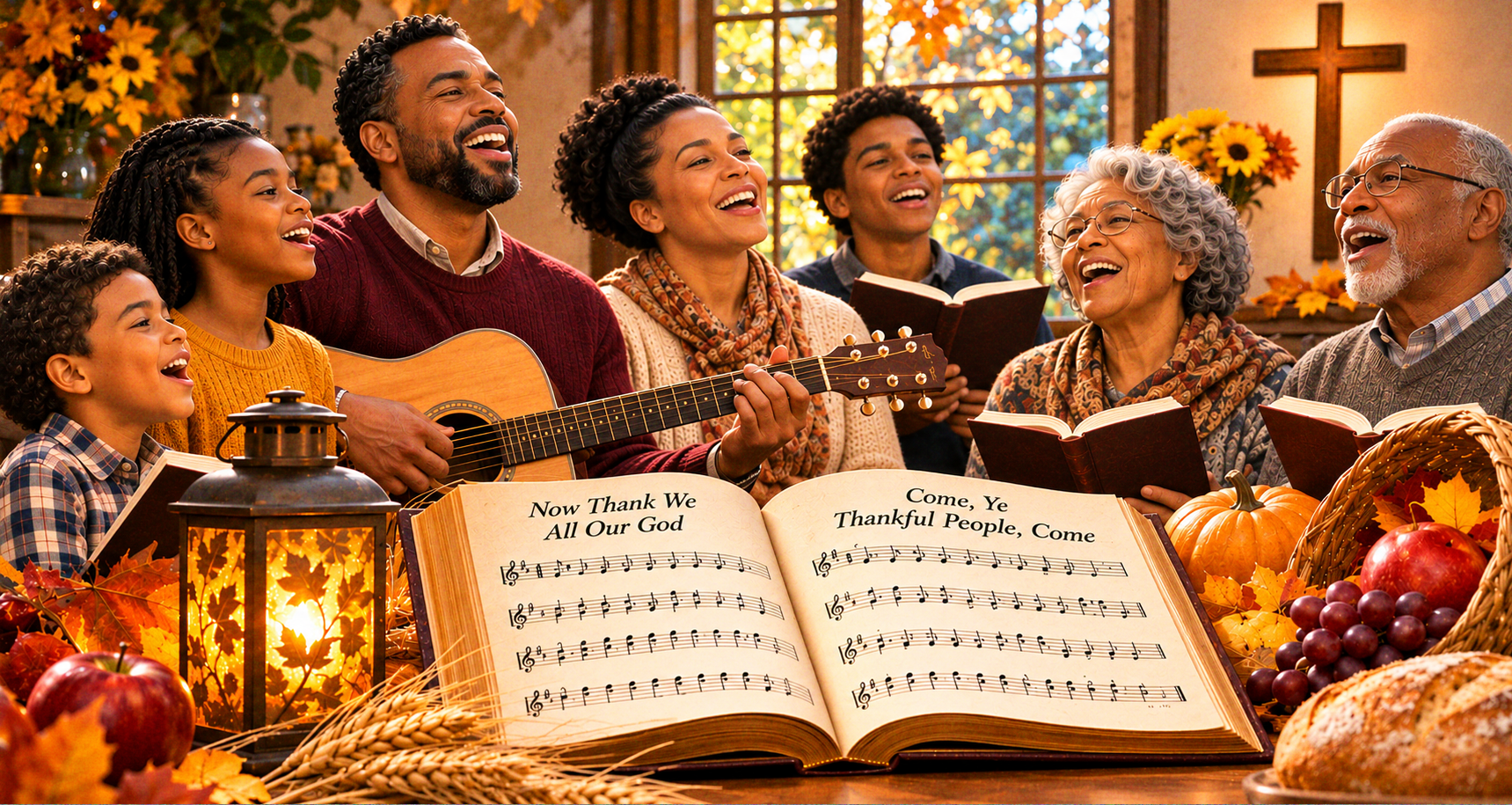
"Give thanks in all circumstances; for this is God's will for you in Christ Jesus." (1 Thessalonians 5:18)
In Luke 17, ten men with leprosy are healed, and only one comes back to say thank you. Jesus notices. "Were not all ten cleansed?" he asks. "Where are the other nine?"
I think about that story every November. Gratitude is easy to feel and surprisingly easy to forget to say. Hymns are one of the oldest tools the church has for saying it out loud, together, in words that someone else has already shaped for us when our own words run out.
This year in the United States, Thanksgiving falls on Thursday, November 26. Here is a short guide to hymns of gratitude, followed by a playlist you can use at the table, in the car, or on the Sabbath before the holiday.
Three Kinds of Thankful Hymns
1. Thanks for the earth and the harvest. These hymns look at the table and the field and see the Giver behind them.
- For the Beauty of the Earth (Folliott Pierpoint, 1864) walks through the gifts of sight, sound, home, and love, and answers each one with praise.
- Come, Ye Thankful People, Come (Henry Alford, 1844) begins with a harvest festival and ends with a larger harvest. It echoes the parable of the wheat and the tares in Matthew 13 and closes with a prayer for Christ's return. Adventist worshipers will notice how naturally it turns from Thanksgiving to hope.
2. Thanks for God's faithfulness. These hymns thank God not only for what we have, but for who God has been to us.
- Now Thank We All Our God is a German chorale by Martin Rinkart, translated into English by Catherine Winkworth. The story often told about it is that Rinkart, a pastor in a town devastated by war and plague in the 1600s, wrote it as a simple table grace. Whether or not every detail is exact, the hymn's strength is that it was not written in easy times.
- Great Is Thy Faithfulness (Thomas Chisholm) sings thanks for "morning by morning" mercies, which suits the quiet gratitude of ordinary days.
- My Maker and My King (Anne Steele) speaks in the first person: "to thee my all I owe." It is gratitude as personal surrender.
3. Thanks as celebration with others. Gratitude was never meant to be only private.
- We Gather Together comes from a Dutch hymn first published in 1626, and is often linked to believers who gathered for worship under pressure. It places thanksgiving in the company of God's people.
- Joyful, Joyful, We Adore Thee (Henry van Dyke, 1907) is set to the melody from Beethoven's Ninth Symphony and sounds like a family reunion in music.
- The Doxology (Thomas Ken, seventeenth century) is just four lines, and has closed countless meals and services.
The Playlist: Hearts Full of Thanks
A suggested listening order, from an opening call to praise through reflection and celebration to a quiet close. The style is our suggestion for each text.
|
# |
Hymn |
Why It's Here |
|
1 |
An opening call to give thanks |
|
|
2 |
Warm, harvest-table joy |
|
|
3 |
Voices only, like a gathered family |
|
|
4 |
Gentle gratitude for ordinary gifts |
|
|
5 |
A personal prayer of thanks |
|
|
6 |
A congregational chorale in a modern setting |
|
|
7 |
A quiet pause for reflection |
|
|
8 |
Good for the family table |
|
|
9 |
A celebratory high point |
|
|
10 |
A closing doxology |
Total listening time depends on the arrangements, but the list is designed for roughly an hour.
Three Ways to Use It
On the Sabbath before Thanksgiving. Sabbath is already a weekly act of gratitude, a day set apart to receive instead of produce. Play tracks 4, 5, and 7 during Sabbath afternoon.
At the table. Before the meal, sing one verse of the Doxology, or play track 8 while the family gathers.
In a small congregation. If you don't have a pianist or a choir, tracks 2, 3, and 6 can be used for a Thanksgiving Sabbath song service. Remember that churches are responsible for any licensing their particular use may require.
When Gratitude Is Hard
I want to say one more thing, because Thanksgiving is not easy for everyone. For some people this season includes an empty chair, a hard diagnosis, a job loss, or a strained family.
Scripture doesn't ask us to pretend. Habakkuk wrote, "Though the fig tree does not bud and there are no grapes on the vines... yet I will rejoice in the Lord" (Habakkuk 3:17-18). That is thanks with open eyes. Several of the hymns above were written in exactly that kind of season. If you can't feel grateful this year, let the hymn say it for you. The words can carry what you can't carry yourself.
A Closing Thought
Of the ten men healed in Luke 17, only one returned, and he was a stranger. It is a reminder that thankfulness is not only a feeling. It is a decision to go back and say so.
This November, go back. Sing it. Play it. Say it out loud.